

At one of the Guernsey Amateur Radio Society’s Friday club meetings, Adrian GU0VLG said it would be an idea for the club to activate one of the many Parks on the Air (POTA) sites on Guernsey. He suggested Lihou Island (POTA ref GG-0005), so this was chosen as the site for the club’s second POTA activation.
The island
Lihou[1] is a small island off the west coast of Guernsey that has been established as a nature reserve.
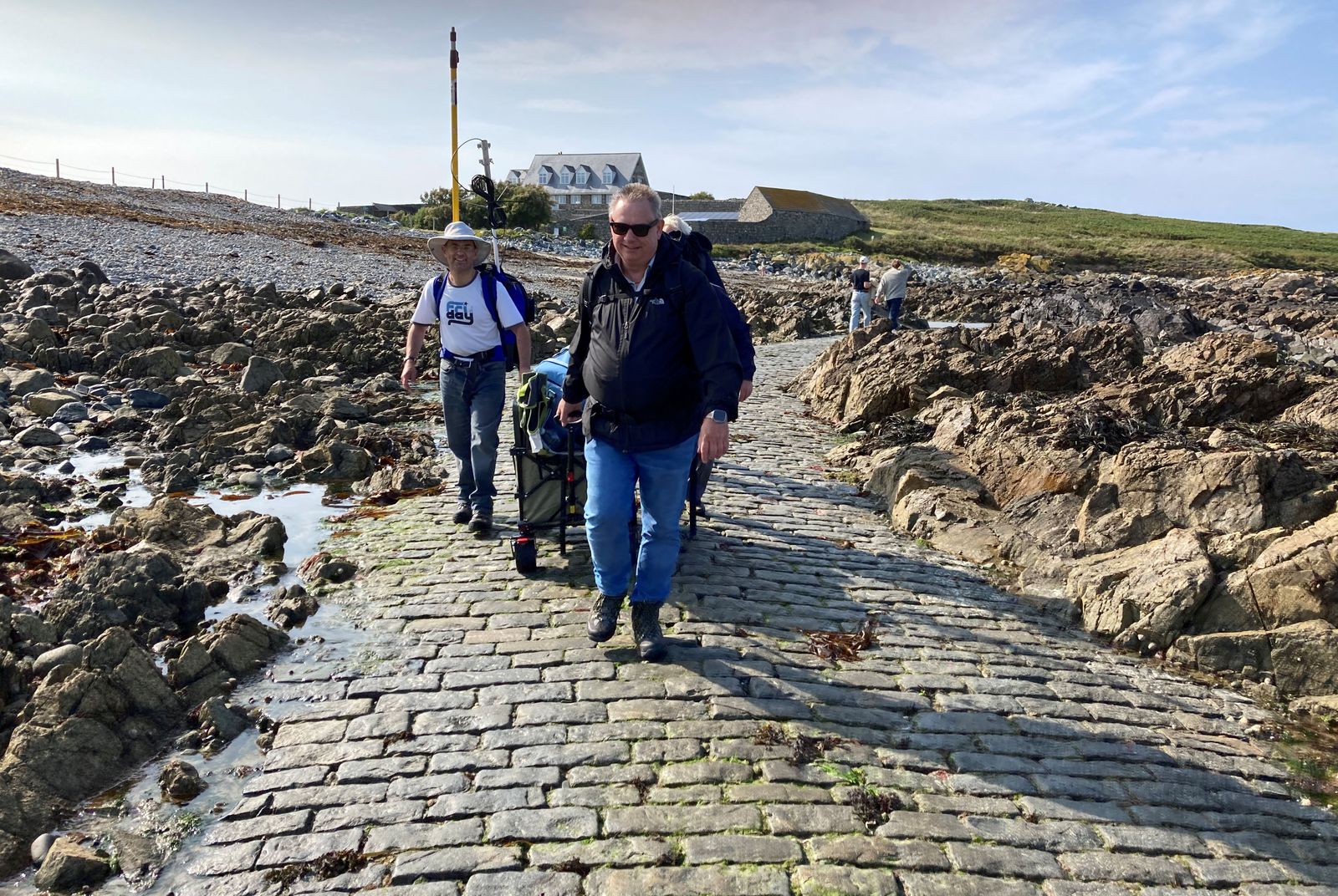
Access to Lihou is via a 600m causeway, cobbled in places, that is only open for short periods during very low tides. Guernsey has a very big tidal range, and with that come some dangerously strong currents, so it is vital that you check the official website[2] for opening times, and do not attempt to cross the causeway at other times.
Once on the island you will discover a ruined monastery, tidal pools and an abundance of wildlife. With Ramsar wetland and marine conservation status, Lihou is a wildlife sanctuary ideal for birdwatching and rock-pooling. Naturally, a site of such importance has rules that need to be observed (no vehicles, no dogs, fires or barbecues, no drones or camping, etc.), and permission is required if you intend to stay on the island outside the times when the causeway is notified as being open.
A rare window
Whilst access to Lihou is normally limited to a two-hour window on days when the causeway is open, there are a few occasions each year when two sufficiently low tides occur on the same day during daylight hours, giving approximately 11 hours in which to operate a POTA station. After scouring the tide tables, Adrian discovered one such day, but it would mean crossing at 05:15 in the morning, in the twilight!
The only caveat was that we must get off the island that evening, or we would be stuck there for the next seven days until the next passable opening of the causeway.
The next challenge was to obtain permission from the local authorities to stay on the island outside causeway times, particularly as we needed to erect a shelter and put up HF antennas. This involved giving assurances that we would not do anything to disturb the wildlife, would have no fires or generators, and would take our litter home.
With a team of enthusiastic POTA operators assembled, we held a planning meeting and created a spreadsheet of everything to be taken. Getting the balance right mattered, as all the equipment would have to be carried by hand.
Bacon rolls at 5am
So, with the date set for Sunday 25 August, we just needed good weather. The Saturday turned out to be a washout, with heavy rain and strong winds, but we awoke at around 04:00 to find a dry (and eventually sunny) day with light winds.
With everything packed, the whole party arrived at the west coast car park at 05:00 to a very pleasant surprise: Simon GU5WZY and his XYL Frederica were waiting for us with bacon rolls and coffee, which were appreciated by all.
Adrian GU0VLG, Keith GU6EFB, Jason GU7DAI, Mark MU7GUF and Dave GU8ITE, armed with a variety of torches, set off in the dark across the winding causeway, parts of which are sandy or covered in shingle and seaweed, which made them very slippery. They were accompanied by Neil GU4XGU, who had very kindly got up early to help carry the kit over to the island (it is suspected he may have gone back to bed after returning to Guernsey). Thank you, Neil.
Jason GU7DAI was leading the party and, just as we were approaching Lihou with the worst of the crossing behind us, he managed to find the one uneven section and ended up on his knees, getting rather wet.
Setting up at sunrise
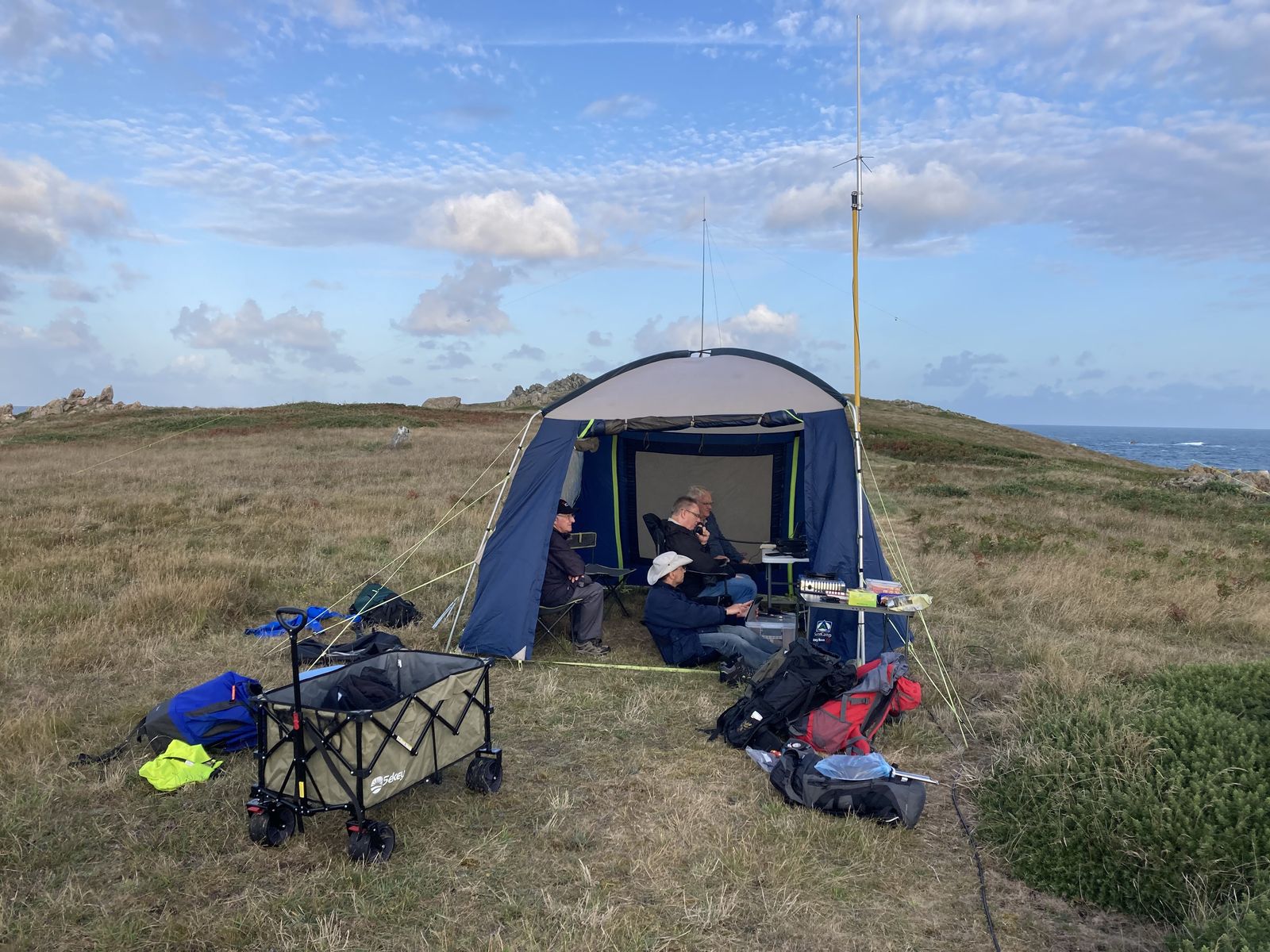
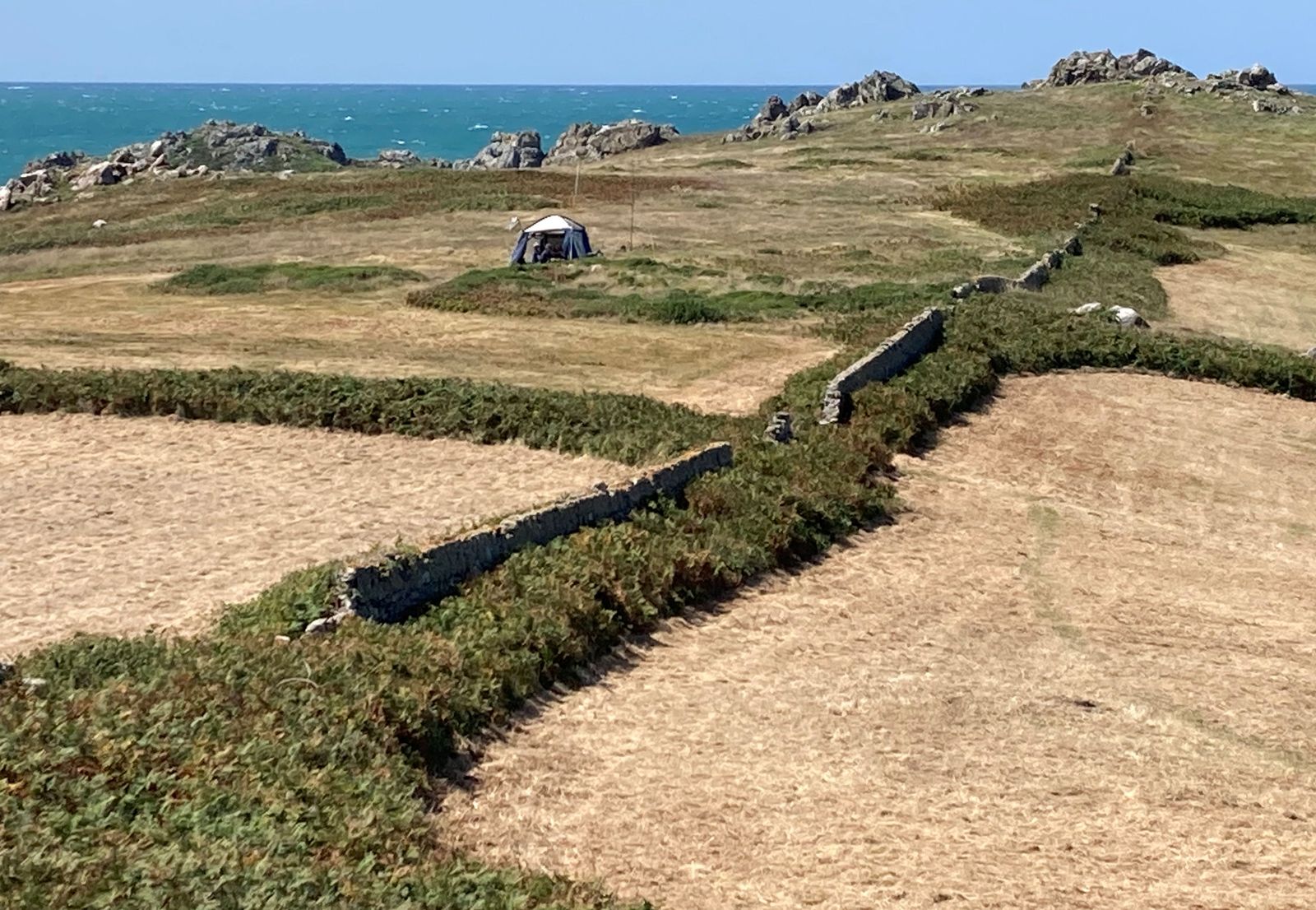
Once on the island we made our way to a high point with a flat section of grassland and started to set up, which was fun as the sun was just starting to rise. It took us about three quarters of an hour to erect the shelter and set up the two radio stations.
Station one · Data
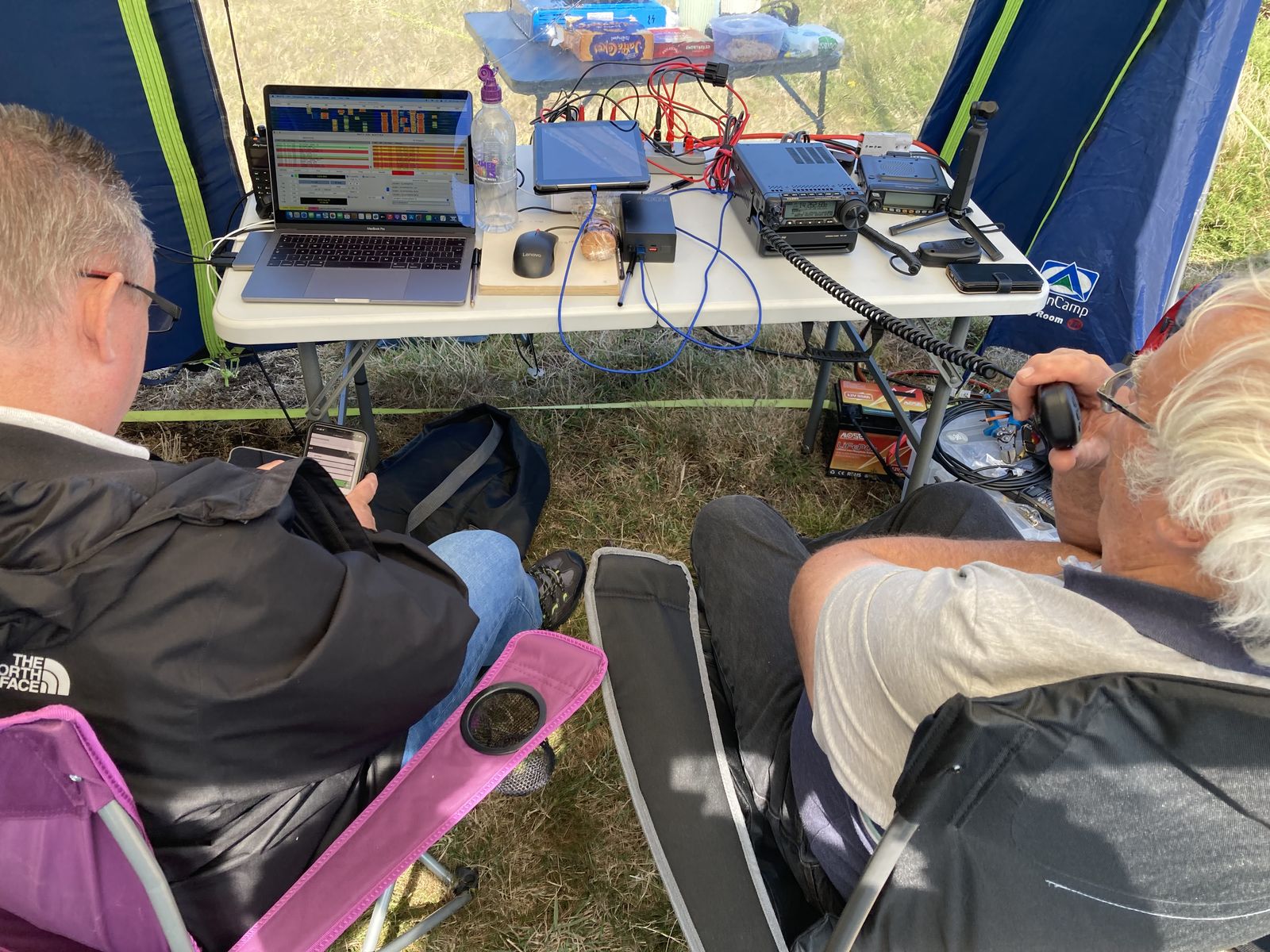
Icom IC-705
- Power
- 10 watts
- Antenna
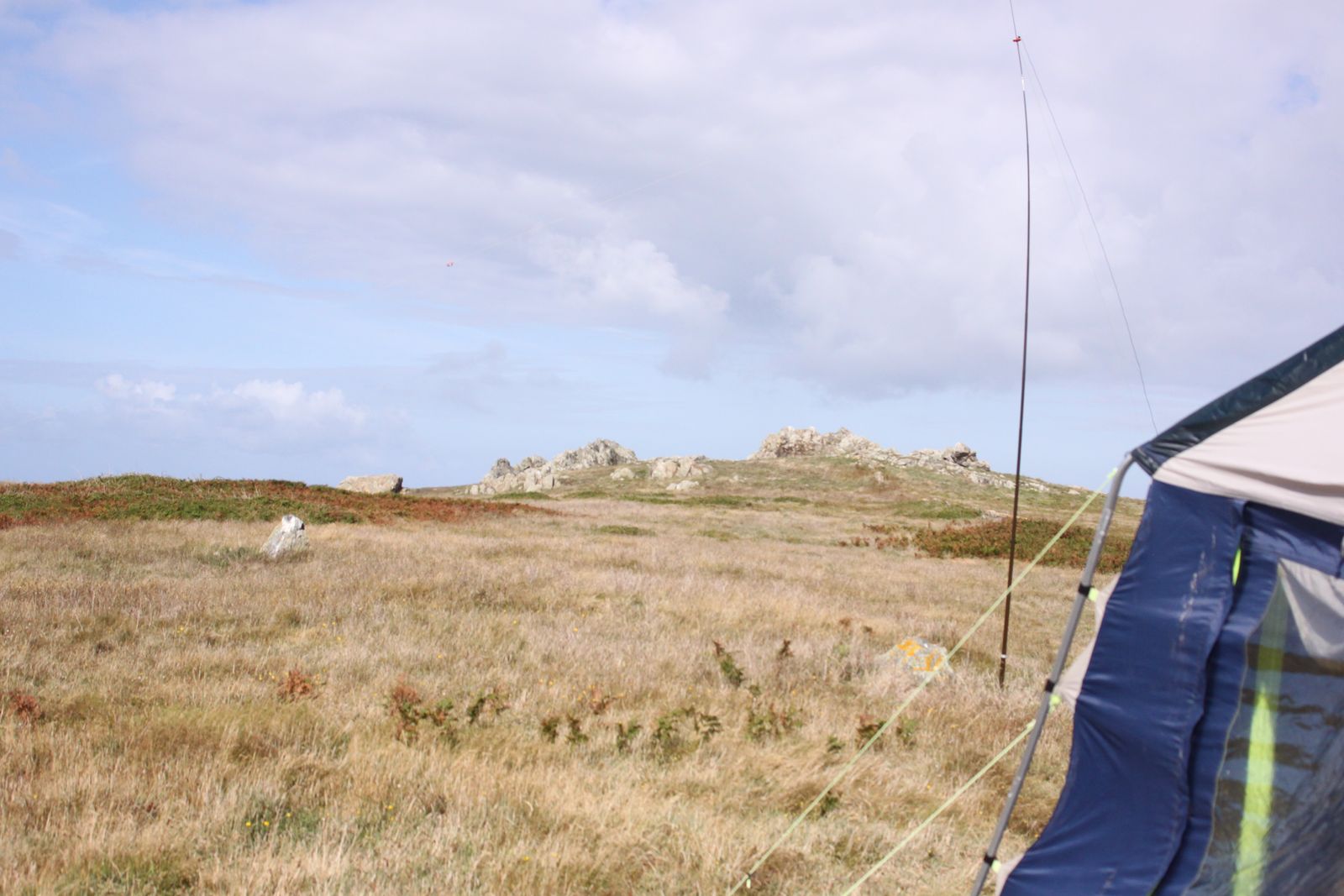
- Inverted-V
- Modes and bands
- FT4 and FT8 on 7, 10, 18 and 21MHz
- Logging
- MacBook, which also ran the data modes
Station two · Voice
Yaesu FT-891
- Power
- 50 watts
- Antenna
- Slidewinder DX multiband HF ground-mounted vertical
- Mode
- SSB
- Logging
- iPad
Power for the day
The station was powered for the day by Jason’s off-grid power station: a Moseworth 50Ah LiFePO4 battery with a Victron SmartShunt (Bluetooth) to help with monitoring. With two radios in constant operation we used about 60% of the capacity. The usable amount is said to be around 80%, so we had one or two hours in hand, depending on usage.
Power distribution was through a MyDel PW-100 four-output distribution box, using wire binding or 4mm banana plug connections: super quick to set up, and a solid, safe and reliable connection to our equipment.
As we were using a MacBook and two iPads for data operation and logging, we also took along a selection of portable power “bricks” to keep them alive as long as possible.
On the air
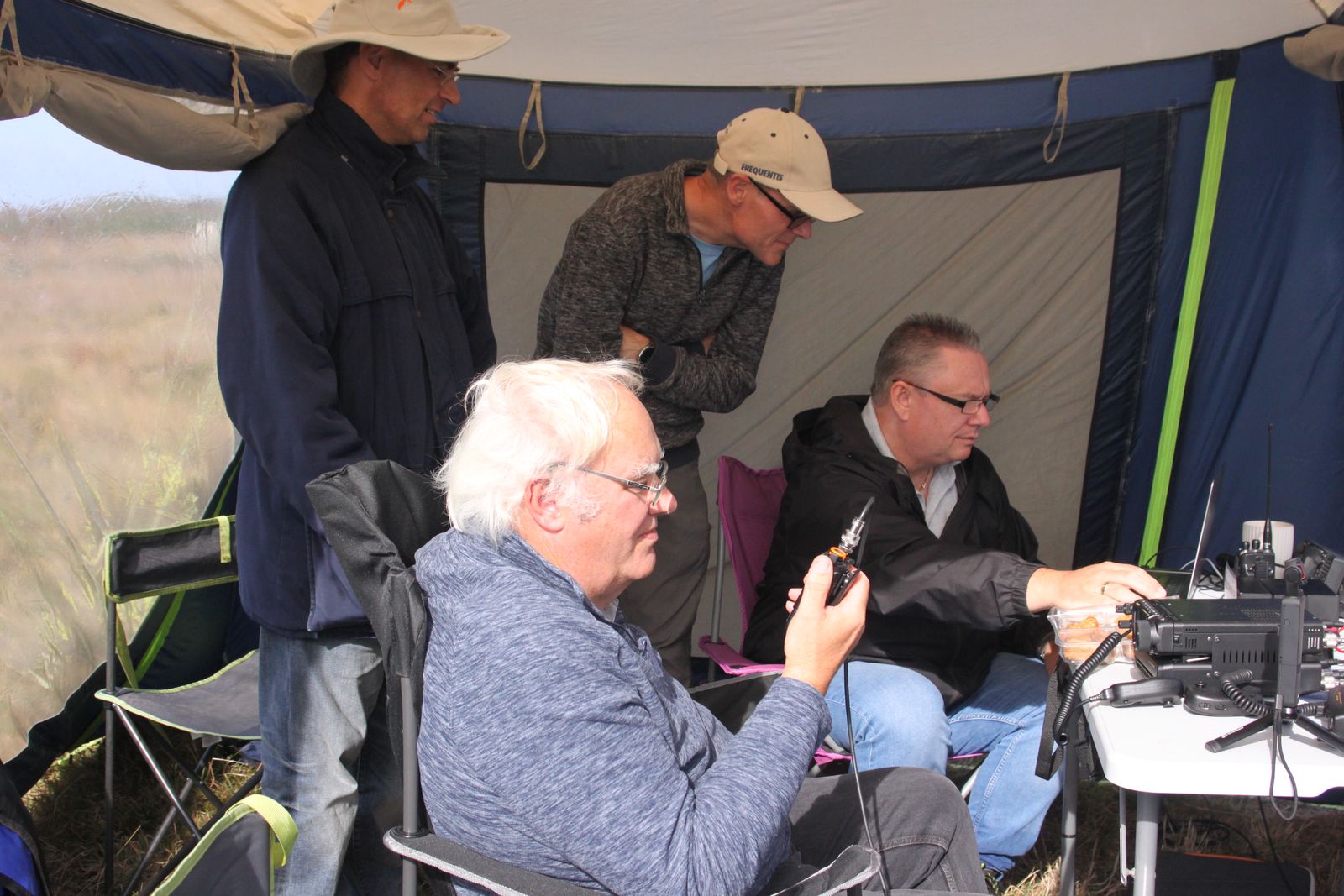
Conditions at the start were very good, with SSB contacts into the United States and the rest of the world, and we were very surprised to be called by Paul, VK2EIR/M, in Australia.
Around lunchtime activity dropped right off. A quick tune around the bands found them almost empty apart from a few contest stations, and even their signals were well below the levels of earlier in the day. Later in the afternoon, signals started to improve.
So how did we do?
We made a total of 197 contacts.
| Band | FT4 / FT8 | SSB |
|---|---|---|
| 15m | 6 | – |
| 17m | 5 | – |
| 20m | 17 | 40 |
| 30m | 30 | – |
| 40m | 71 | 28 |
| Total contacts | 129 | 68 |
| Unique callsigns | 124 | 68 |
It was an enjoyable way to spend a Sunday, and we all made it safely back to the main island of Guernsey.
A new licensee’s view
Mark MU7GUF had been licensed for just four weeks. This is what he thought of the experience.
Being relatively new to the world of amateur radio, I jumped at the chance to be involved in the club’s recent expedition to Lihou Island to activate it as a POTA site.
Despite an early start to catch the low tide, we made our way slowly across the tidal causeway in the semi-darkness, over large patches of slippery seaweed and rough, wet, sandy shoreline, loaded with rucksacks full of kit, trying not to fall over or let the trolley full of equipment get bogged down. We arrived on the island about 30 minutes later with no major spills.
We quickly made our way to an open patch on the island and began setting up. Thanks to the diligent planning by the other, more experienced members, we had all the kit we needed and were up and running before too long with three rigs: two HF for voice and data contacts, and one VHF for voice. Throughout the set-up, the others answered any questions I had.
Within a few minutes of telling the world via the POTA website that we were available, we began logging contacts. I am still lagging behind when it comes to recognising country callsigns, but the calls were coming in thick and fast, with the others telling me where each contact came from. I started off logging the voice calls, moving on to operating FT8 later; I also gained some experience tuning the Slidewinder DX coil antenna whenever we switched between 20m and 40m.
Mid-morning was the club’s regular 2m After-News Net, held after the GB2RS News. I managed to take part in the group chat without too many mistakes (I hope…). It was also about this time that the contacts slowed to a crawl for an hour or two.
After that quiet period the rate picked up again, and we were back to making plenty of contacts before close-down at 14:30 UTC came round (we had to be packed up and ready to cross the causeway by 15:30 UTC, or we would be marooned there for a week).
“I finally plucked up the courage to make my first ‘proper’ contact since being licensed, on 20m voice, just before close-down.”
Mark MU7GUF
It might have been two contacts were it not for what I felt was poor radio etiquette from other stations, who transmitted before the sign-off was complete. Apologies to the other club members who kept saying “NOW!”, trying to get me to transmit before the offending parties did, only for me to hesitate a split second too long and miss my chance. Another of our party did eventually manage to contact the station I kept missing…
Close-down and packing up were done quickly, and we made our way back to the causeway for the crossing on time.
All in all, a fantastic POTA expedition for me, and hopefully the first of many. We were very fortunate with the weather: generally bright with sunny periods all day, apart from a brief shower late in the morning, plus a persistent wind at our exposed location, which our shelter was able to withstand… just about!
Thank you
Thanks go to all of the following club members for making the day such a success:
- The expedition partyAdrian GU0VLG, Dave GU8ITE, Jason GU7DAI, Keith GU6EFB and Mark MU7GUF
- Our helpful “sherpas”Neil GU4XGU and Koos GU0GUX, who carried kit to and from Lihou
- The field kitchenSimon GU5WZY and his wife Frederica, who met us at 5am with hot coffee and bacon rolls
- The welcome homePhil GU0SUP, who came to meet us on our return
Article written by Dave Eaton GU8ITE, originally for RadCom.
[1] Lihou Island: www.lihouisland.org.gg
[2] Causeway opening times: www.gov.gg/lihou
← Back to History